Introduction To the Ceribell Rapid Response EEG System
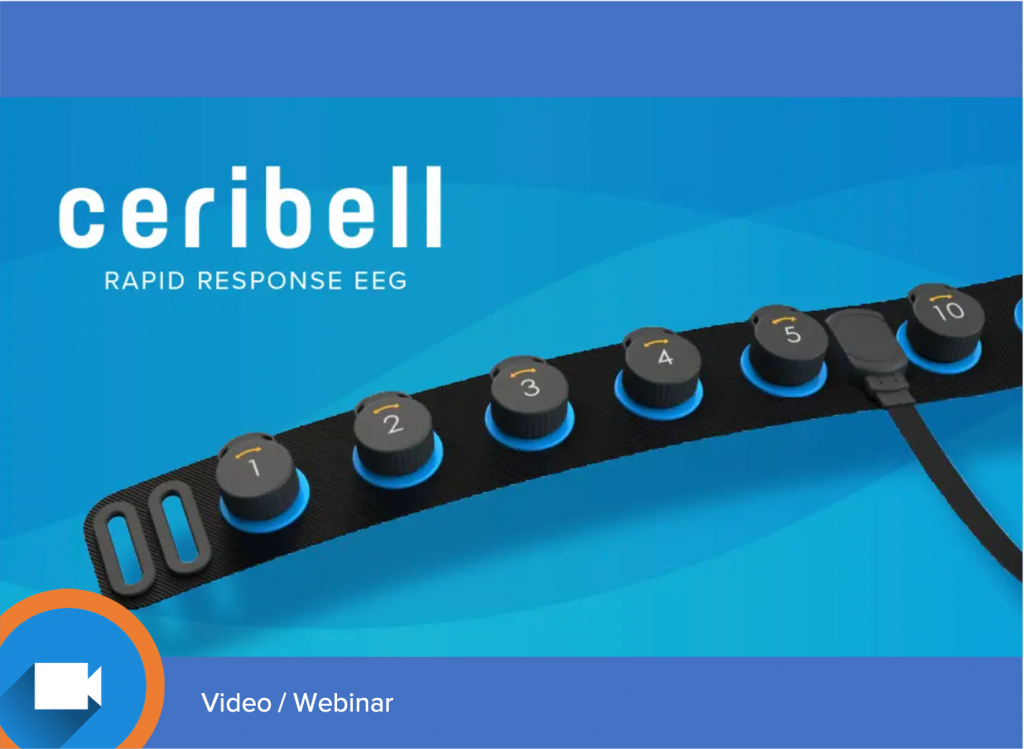
Patients experiencing prolonged seizures are at higher risk of mortality, secondary brain injury, length of stay, and complications. Non-convulsive seizures, which show no outward signs, are a very common medical emergency in severely ill patients, but they can only be diagnosed using electroencephalography (EEG). Conventional EEG systems are not designed to be readily available for […]
Rapid EEG for Cardiac Arrest Patients Manuscript: Reduced EEG Montage Has A High Accuracy In the Post Cardiac Arrest Setting
Reduced EEG montage like that used by Ceribell Rapid EEG has a high accuracy for seizure triage in the post cardiac arrest setting A reduced electrode montage may be used for post cardiac arrest EEG monitoring Background patterns were almost perfectly assessed with a reduced montage Discharge patterns were identified with high accuracy
Brain Stethoscope Study Manuscript: Rapid Evaluation Of Seizures In the ICU
The Ceribell EEG System offers rapid EEG acquisition and conversion of EEG signals to sound (sonification) using a proprietary algorithm Ceribell EEG System (1) reliably provided rapid emergent EEG data, (2) accurately identified subclinicial seizures, (3) resulted in fewer non-seizing patients being treated, and (4) was easy to use by clinicians not trained to place […]
Brain Stethoscope Study Manuscript: Detecting Silent Seizures By Their Sound
Individuals without any prior EEG training can accurately determine whether the EEG represents seizures or nonseizure conditions Individuals without EEG training can detect ongoing seizures or seizure-like rhythmic periodic patterns by listening to sonified EEG Nonexperts listening to single-channel sonified EEGs detected seizures with remarkable sensitivity (students, 98%±5%; nurses, 95%±14%) compared to experts or nonexperts […]
DECIDE Study Editorial: Sonification of Seizures: Music to Our Ears
The study makes a significant contribution to the ongoing efforts to improve access to real-time EEG acquisition and reduce time to diagnosis The novel use of a simplified EEG montage paired with sonification system may be valuable in the acute assessment of patients with suspected NCSz, leading to more accurate diagnostic decision-making and increasing physicians’ […]
Rapid EEG in Tertiary Care Manuscript: Utility of Rapid EEG – Experience From a Tertiary Care Medical Center
Assessing the utility of continuous and spot EEG in a tertiary care center by quantifying access time and diagnostic yield Even in a modern United States tertiary care setting with state-of-the-art EEG practice and 24 h on-call EEG technician services, there is a noticeable delay in access to EEG EEG access time was 3.7 ± […]
Rapid EEG in Community Hospital Manuscript: Rapid Response EEG For Urgent Evaluation of Patients In A Community ICU
This report confirms the ease of use and speed of acquisition and interpretation of Rapid EEG information Conventional EEG was significantly delayed (11.2 ± 3.6 hours) compared with RR-EEG (5.0 ± 2.4 minutes; P < .005) Use of RR-EEG helped clinicians rule out status epilepticus and prevent overtreatment in 4 of 10 cases [40%] RR-EEG […]
Circumferential Montage Manuscript: Diagnostic Value of Electroencephalography with Ten Electrodes in Critically Ill Patients
EEG recordings using a circumferential 10-electrode montage meet the gold standard for seizure detection Removing confounding factors, the overall concordance between fm-EEG and rm-EEG increased from 79.7% to 99.0%, and the sensitivity and specificity of rm-EEG compared to fm-EEG in detecting seizure cases increased to 97.5% and 100.0%, respectively. The concordance between fm-EEG and rm-EEG […]
Clarity AI Study Manuscript: Monitoring the Burden of Seizures in Critical Care with a Novel Machine Learning Method
Ceribell with Clarity provides 24/7 EEG monitoring with consistently high performance for seizure burden assessment and bedside alert Of the 179 EEG recordings in which Claritγ detected no seizures, [Clarity had a] negative predictive value of 99%. Individual expert raters displayed variability in both sensitivity (range 20–89%) and specificity (range 94–99%). The sensitivity for identifying […]
DECIDE Study Manuscript: Assessing The Impact of Ceribell Rapid Response EEG
Ceribell™ Rapid Response EEG was demonstrated to significantly improve clinical accuracy and confidence A substantial number of critically ill patients with altered mental status have nonconvulsive seizures; data suggests a clear association between prolonged nonconvulsive seizures and poor neurologic outcomes However, even in large academic medical centers with 24/7 in-house EEG technologists, access to conventional […]
Safe ICU Monitoring During the COVID-19 Pandemic
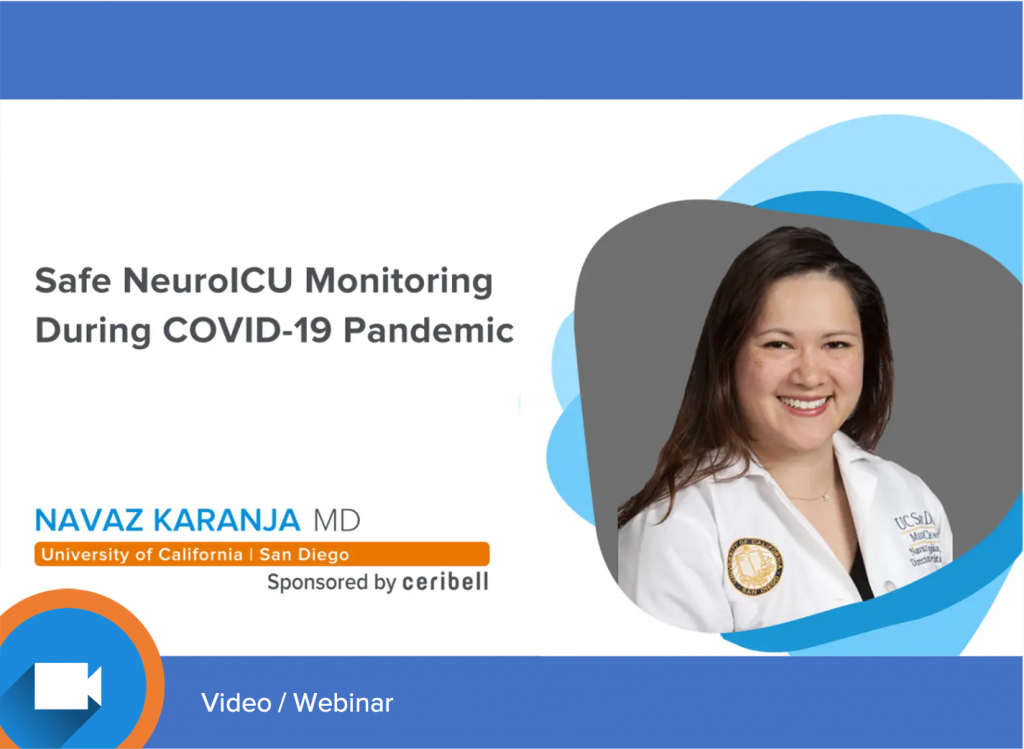
Dr. Navaz Karanja discusses safe NeuroICU EEG monitoring during the COVID-19 pandemic. Dr. Karanja is a neurointensivist who completed her neurology residency at UCLA and neurocritical care fellowship at Johns Hopkins. She is the founding director of the University of California San Diego’s Neurocritical Care program and NeuroICUs, and the chair of the Quality Committee […]
Tulane University – Impact of COVID-19 on Critical Care EEG
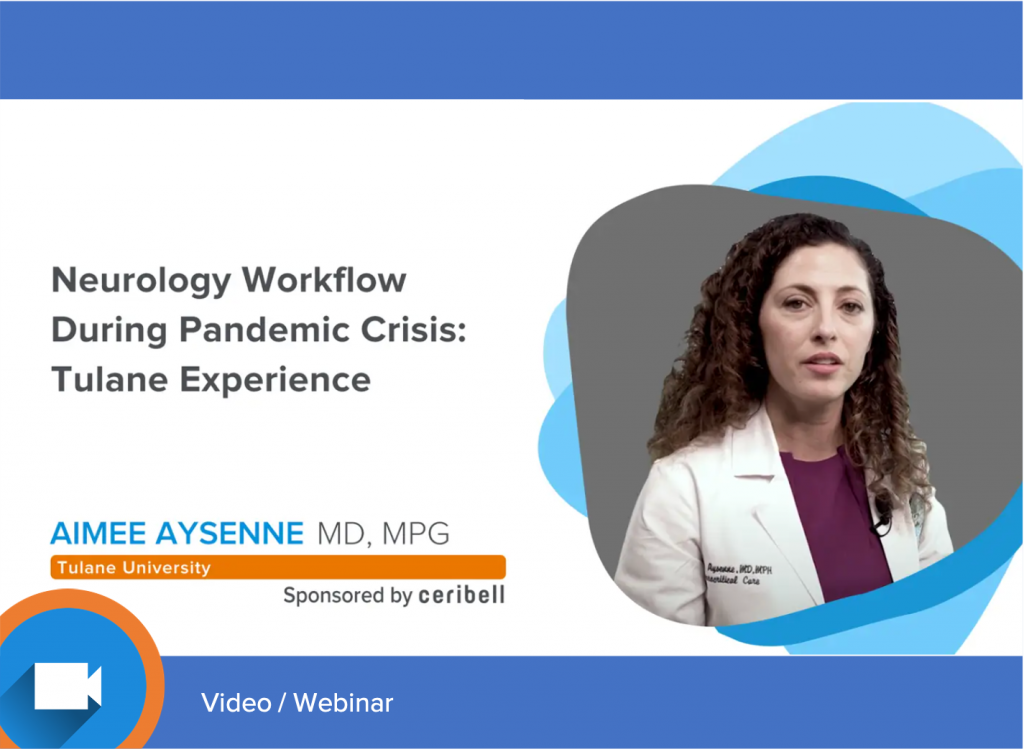
Dr. Aimee Aysenne shares experiences and impact of the COVID-19 pandemic and practice and protocols for critical care EEG monitoring. Dr. Aysenne is a neurointensivist at Tulane University School of Medicine where she serves as Vice Chair of Clinical Neurosciences, Medical Director of Neurocritical Care and Telestroke. She has an interest in severe neurological injury, […]